Navigating Angry Conversations
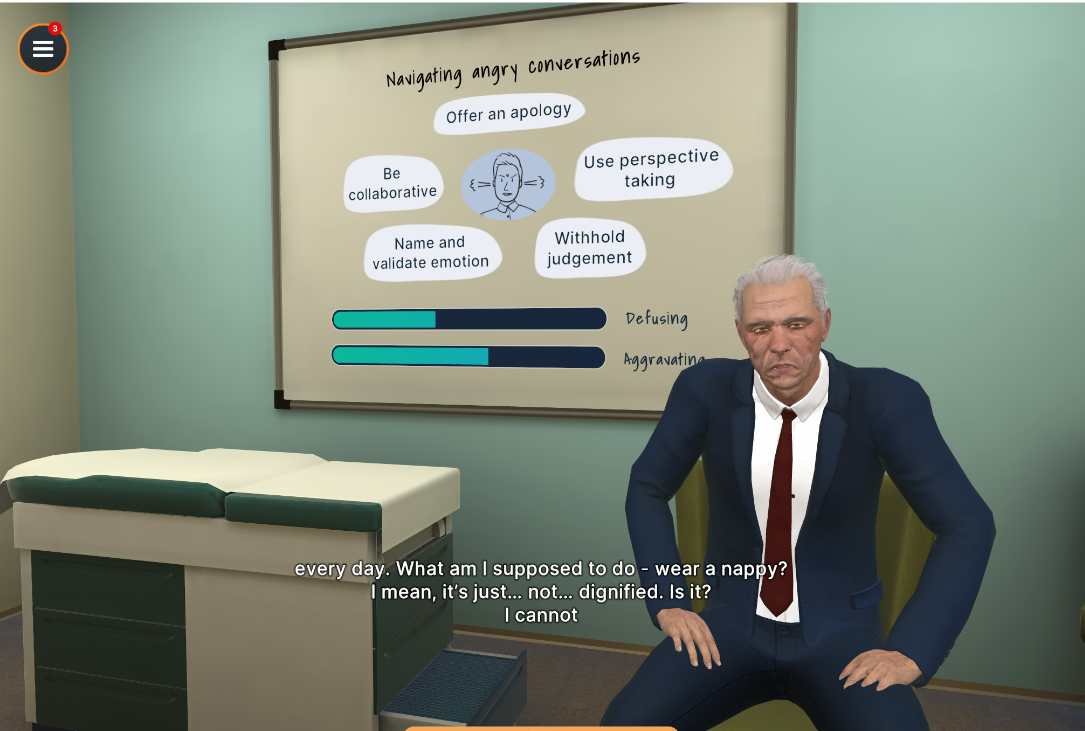
VR training to help new doctors improve patient communication.
00:00
/
00:00
By the end of this series, healthcare professionals will gain the following learning objectives:
- Understanding how different responses can defuse or exacerbate anger
- Identifying anger signals
- Remaining calm in hostile situations
- Responding with empathy to move the situation forward
- Applying these techniques to different situations
Learning these techniques in 'the heat of the moment' can be difficult - and potentially dangerous. Our simulations provide a safe space in which to put the theory into practice and become more comfortable with the methods before using them in real-life interactions with real people.
This comprehensive module is designed for a diverse range of learners and a broad range of competency levels.
It’s particularly beneficial for:
- Medical Schools and Health & Social Care programs: Supports the development of foundational interpersonal and communication skills. This module was built with subject matter expertise from the Royal Society of Medicine. Supports the development of key staff-patient communication skills in a variety of situations.
- Healthcare institutions: Equips practitioners and students with vital interpersonal communication skills to enhance staff-patient interactions.
- Nursing Programs: This module's learning objectives are aligned with The Essentials: Core Competencies for Professional Nursing Education (“The Essentials”) a publication owned by the American Association of Colleges of Nursing, which may be accessed here.
Languages
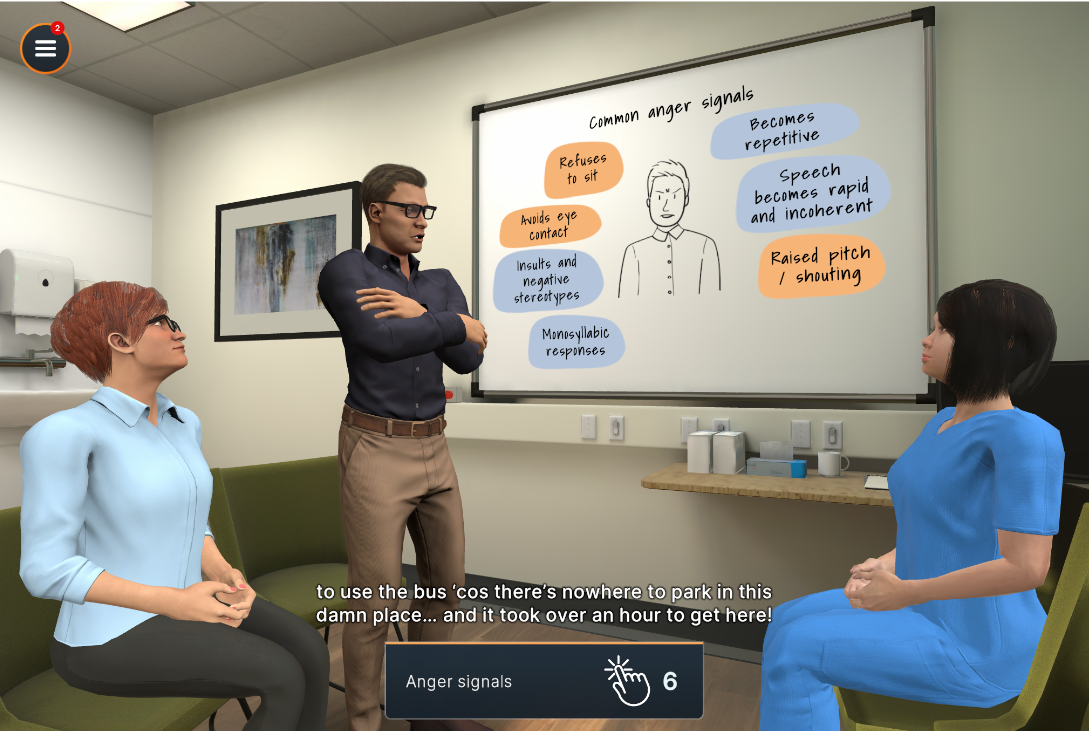
Handling angry patients and relatives is one of healthcare practitioners' greatest challenges. As pressures on the NHS grow, staff are experiencing increasing levels of verbal abuse from the frustrated public. The emotional and physical cost of such encounters is high - not only for the doctor involved but also for other patients, colleagues and family. This immersive training is designed to build effective communication skills that will help with emotionally charged patient interactions and personal relationships. Created in collaboration with The Royal Society of Medicine (RSM).
What is Custom VR Builds?
It’s a service where Next World creates a fully tailored VR-training solution for your company — a custom course built to meet your industry-specific requirements rather than using a generic off-the-shelf VR module.
How does the custom-build process work?
The process typically follows these phases: you provide training documentation, subject-matter experts get involved, learning outcomes are identified, storyboard is created, virtual assets are modeled, testing and quality assurance, and finally deployment in your environment.
What type of training scenarios can be built?
You can build VR scenarios for hazard awareness, safe-practice with tools and equipment, practicing safety procedures step-by-step, and even testing learner’s knowledge in simulated hazardous situations — as if in real life but safe.
Is custom VR suitable for refresher training as well?
Yes — custom VR builds can be used for refresher/training-update courses to efficiently refresh skills and knowledge without re-arranging real equipment or putting people at risk.
What learning methodology does custom VR follow?
Next World suggests a blended approach: combining face-to-face, practical and immersive training methods, which helps improve retention, practical competence, and reduces incidents.