
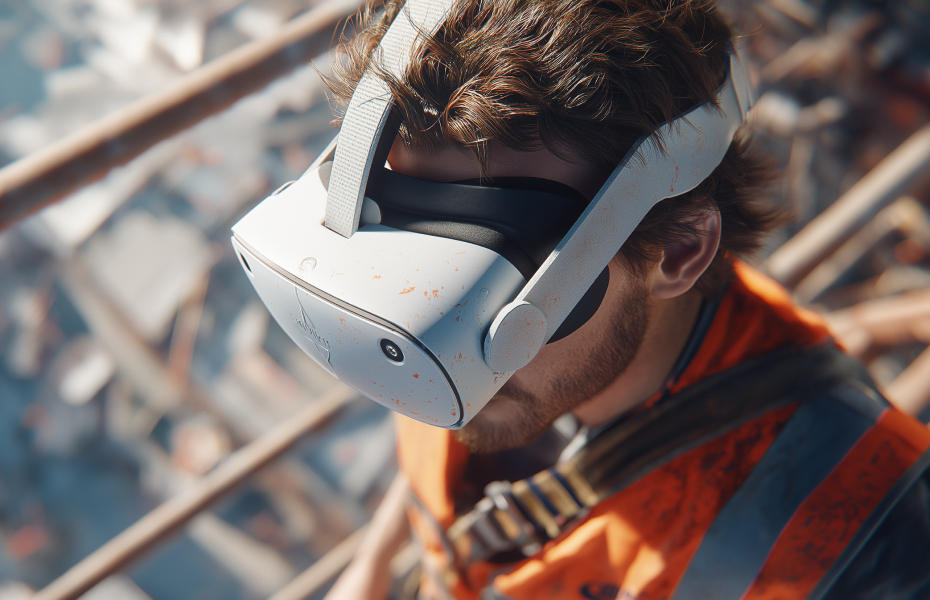
Construction safety meeting topics shape how crews think about risk before they pick up a single tool. When those topics are delivered well, workers stay alert, speak up about hazards, and make better decisions under pressure.
When they fall flat, safety becomes background noise. The challenge is not choosing what to talk about. It is making the conversation stick. That is where virtual reality simulations are proving their value, turning routine briefings into experiences that workers actually remember.
Why Safety Meeting Topics Matter More Than You Think
Toolbox talks and safety briefings are a staple of construction work. They happen at the start of every shift on well-managed sites, covering everything from PPE inspections to task-specific hazards. But a five-minute talk delivered to a group of workers standing in a car park only goes so far. Workers hear the words, sign the attendance sheet, and move on.
The topics themselves are not the problem. Fall protection, electrical safety, confined space entry, and manual handling are all critical subjects.
The problem is how they are delivered. Passive delivery leads to passive retention. When workers can step inside a realistic scenario and practice their response, the lesson moves from short-term memory into something far more durable.
Fall Protection and Working at Heights
Falls remain the single biggest killer on construction sites. Whether the work involves scaffolding, roof sheeting, ladder access, or elevated platforms, the risks are constant and the margin for error is slim. This makes fall protection one of the most critical topics you can cover in a safety meeting.
Traditional toolbox talks on fall protection usually involve reminding workers to inspect harnesses, check anchor points, and maintain three points of contact on ladders. All of that matters, but it is difficult to convey the real consequences of a mistake through words alone. VR simulations change that equation.
Workers can practice inspecting fall arrest systems, identify defective equipment, and experience working at height in a controlled virtual environment, building the situational awareness that classroom instruction simply cannot replicate.
Hazard Identification and Site Walkthroughs
Every construction site is different, and hazards shift as projects progress through different phases. One week the major risk might be excavation work. The next, it could be overhead crane operations or live electrical systems. Teaching workers to actively scan their environment and spot hazards before they cause harm is a foundational safety skill.
Effective hazard identification training goes beyond listing common risks. It trains workers to think critically about their surroundings, question assumptions, and report what they see.
VR takes this further by placing workers in virtual construction sites where hazards are embedded throughout the environment. Workers walk through the site, identify risks, and receive immediate feedback on what they caught and what they missed.
Confined Space Entry and Atmospheric Hazards
Confined space work is among the most dangerous activities on any construction site. Tanks, manholes, pipelines, and utility vaults all present risks including oxygen depletion, toxic gas accumulation, and limited escape routes. What makes these incidents especially deadly is that rescue attempts often result in additional casualties.
Covering confined space procedures in a safety meeting means discussing permit requirements, atmospheric monitoring, entry and exit protocols, and emergency rescue plans.
VR simulations allow workers to practise the full sequence of a confined space entry without any real exposure, reinforcing proper procedures in a way that printed checklists alone cannot achieve.
Fire Prevention and Emergency Response
Construction sites carry significant fire risk due to hot work, temporary electrical installations, and flammable materials. Fire prevention should be a regular rotation in your safety meeting schedule, covering ignition source control, fire watch requirements, and extinguisher selection.
VR adds real urgency to this training. Workers can practice identifying the correct extinguisher class for different fire types, applying the PASS technique under pressure, and making sound evacuation decisions when smoke fills a virtual space.
When paired with your existing evacuation drills procedures, VR-based fire training creates a much stronger safety response across your crew.
Manual Handling and Ergonomic Risks
Musculoskeletal injuries are among the most common and costly issues in construction. Lifting heavy materials, repetitive motions, awkward postures, and sustained physical effort all contribute to strains, sprains, and long-term damage.
Unlike a dramatic fall or electrical contact, these injuries develop gradually, making them easy to overlook until the damage is done.
Standard talks on manual handling cover proper lifting technique, team lifting procedures, and the use of mechanical aids. VR training enhances this by simulating realistic lifting scenarios where workers must assess loads, choose the right approach, and apply correct body mechanics before those habits lead to injury.
Electrical Safety and Lockout Tagout
Electrical hazards on construction sites range from contact with overhead power lines to faulty temporary wiring and energized equipment. Electrocution is one of the "fatal four" hazards identified in construction, and even experienced workers can become complacent around electrical systems.
Covering lockout tagout procedures, safe isolation practices, and the dangers of working near live circuits should be a recurring topic. VR simulations allow workers to practise the full lockout tagout sequence on virtual equipment, verify isolation before starting work, and respond to electrical incidents without real-world consequences.
Building a VR-Enhanced Safety Meeting Programme
Integrating VR into your safety meetings does not mean abandoning traditional toolbox talks. The most effective programs blend both approaches. Use short briefings to set the context, then follow up with VR sessions where workers practise what they have just discussed.
Tracking performance data from VR sessions gives safety managers measurable evidence of individual competency. That data informs targeted coaching and helps you focus future meetings where they are needed most. This approach aligns with building a stronger safety culture that drives continuous improvement across the organisation.
Recommended VR Modules for Construction Safety Meetings
The following Next World modules align directly with the safety meeting topics covered above. Each delivers immersive, scenario-based training that reinforces the skills your crew needs most.
- Workers identify fall hazards across rooftops, scaffolds, and elevated job sites in a realistic 12-minute simulation built from recognized units of competency.
- Includes a full site safety risk inspection under exam conditions, giving you measurable proof of each worker's hazard recognition ability.
- Trainees practise selecting fall protection equipment including harnesses, guardrails, and tethered tools, building confidence before they leave the ground.
- Covers the complete entry sequence from permit signing and atmospheric testing through to lockout tagout, task execution, and safe exit documentation.
- Workers practice bump testing gas detectors, reading atmospheric levels, and responding to hazardous conditions inside a simulated compressor tank.
- Builds muscle memory for critical procedures that are difficult and dangerous to replicate in live training.

- Trainees learn all six fire classes, match each to the correct extinguisher type, and apply the PASS technique in dynamic scenarios where smoke fills the room.
- Creates real urgency without real danger, giving workers repeated practice that builds speed and accuracy under pressure.
- Color-coded extinguisher identification and scenario-based assessment ensure workers can act decisively when seconds count.
- Walks workers through the full eight-step LOTO procedure across multiple machinery types, covering energy isolation, device application, and verification.
- Trainees identify and respond to LOTO failures in real time, reinforcing instinctive safety behaviours that prevent fatal energy release incidents.
- Covers all hazardous energy sources including electrical, pneumatic, thermal, and mechanical, giving workers comprehensive isolation knowledge.
Frequently Asked Questions (FAQs)
1. What Are the Most Important Construction Safety Meeting Topics?
The most important construction safety meeting topics include fall protection, hazard identification, confined space entry, fire prevention, manual handling, electrical safety, and lockout tagout procedures. These cover the highest-risk activities on most construction sites.
2. How Often Should Safety Meetings Be Held on Construction Sites?
Safety meetings should be held at the start of every shift or at minimum once per week. Daily toolbox talks are standard practice on well-managed sites, with longer sessions scheduled for high-risk activities or when site conditions change.
3. Can VR Replace Traditional Toolbox Talks?
VR is not a replacement for traditional toolbox talks. It works best as a complement, reinforcing topics covered in briefings with immersive practice. The combination of verbal instruction and VR simulation produces stronger retention and better on-site behavior.
4. What Types of VR Simulations Are Available for Construction Safety?
VR simulations cover a wide range of safety meeting subjects relevant to construction, including fall protection, hazard recognition, confined space entry, fire extinguisher use, manual handling, and electrical safety. Modules can be tailored to match specific site conditions.
5. How Does VR Training Improve Safety Meeting Outcomes?
VR training improves outcomes by shifting workers from passive listening to active participation. Workers practice real procedures in realistic scenarios, receive immediate feedback, and build muscle memory. Performance data from VR sessions helps safety managers identify skill gaps and target future construction safety meeting topics accordingly.
Author:

Share Article:
Author:
Share Article: