
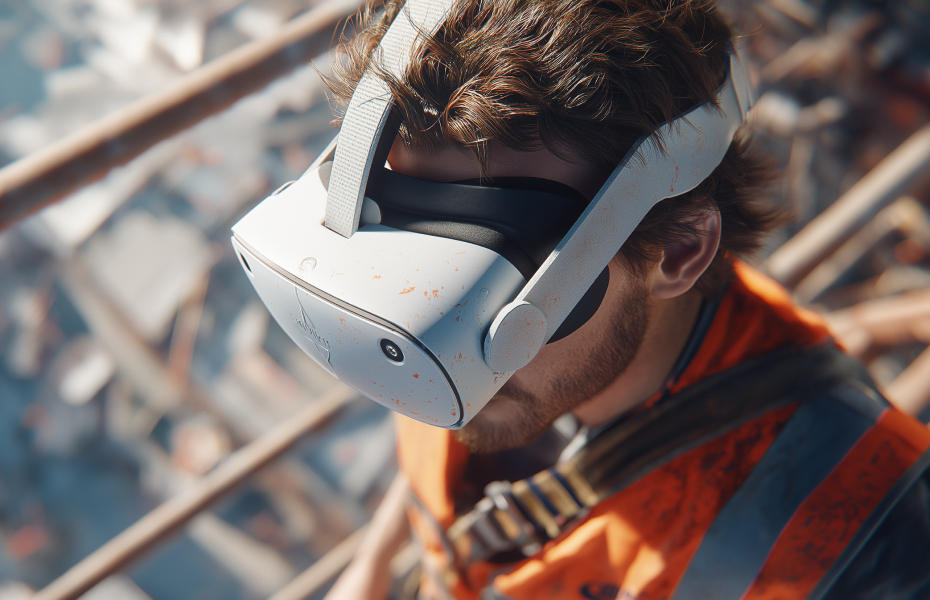
Safety netting construction is one of the most critical fall protection measures on any jobsite, yet it remains one of the most difficult to train for using traditional methods. Falls are the leading cause of death in construction, accounting for nearly forty percent of all fatalities in the industry.
In a single year, over four hundred construction workers died from falls to a lower level, and the majority of those fatal falls occurred from heights between six and thirty feet, precisely the range where safety nets are most commonly deployed.
Training workers to install, inspect, and work around safety net systems demands hands-on experience with scenarios that are inherently dangerous to replicate in a real training environment.
Virtual reality solves this problem by placing workers inside realistic high-risk simulations where they can practice net installation procedures, identify deficiencies, and experience the consequences of errors without any physical risk.
Why Safety Net Training Needs a Different Approach
Safety net systems are one of three primary fall protection methods recognized by regulatory bodies, alongside guardrails and personal fall arrest systems.
Regulations require nets to be installed no more than thirty feet below the working surface, to extend outward from the outermost projection of the work area, and to be drop-tested after initial installation, relocation, major repair, and at six-month intervals.
Mesh openings must not exceed six by six inches, and border ropes require a minimum breaking strength of five thousand pounds.
These are precise, technical requirements. Getting them wrong can be fatal. Yet traditional training struggles to convey the practical realities of working with safety net systems.
Classroom instruction can explain regulations, but it cannot give workers the physical experience of assessing net placement or identifying installation defects at height. On-site demonstration is limited by the obvious problem that creating a realistic fall scenario puts workers in exactly the danger the training is supposed to prevent.
This gap between theoretical knowledge and practical competence is where most training failures occur. Workers understand the rules but lack the procedural fluency to apply them consistently under real working conditions. Immersive learning through VR closes this gap by providing the hands-on experience that classroom methods cannot deliver.
How VR Simulations Address High-Risk Training
VR training for safety netting construction places workers in a realistic virtual jobsite where they interact with net systems as they would on an actual project.
The simulation replicates the physical environment at height, including the visual depth cues, spatial relationships, and structural context that workers need to develop accurate judgement about net placement and condition.
Within these simulations, workers practice a range of critical tasks. They assess whether nets are positioned at the correct distance below the working surface.
They check outward extension distances, inspect mesh integrity and connection spacing, identify foreign objects that need removal, and experience what happens when systems are improperly installed, seeing the virtual consequences of gaps, insufficient clearance, or degraded components.
The emotional engagement of VR is particularly important for fall protection training. Workers who experience a simulated fall in VR develop stronger risk awareness than those who simply hear about fall hazards in a classroom.
The visceral response to standing at a virtual height creates lasting behavioral change that passive instruction cannot achieve. Workers retain seventy-five to eighty percent of what they learn through immersive virtual training, compared to five to twenty percent from lecture-based methods.
Key Scenarios for VR Net Safety Training
Effective VR programs for safety netting construction cover the full range of scenarios workers encounter on real projects.
- Installation assessment is the foundational scenario. Workers must evaluate whether a net system meets regulatory requirements before any work begins overhead.
The simulation presents nets with varying installation quality, and workers must identify which installations are compliant and which have defects that need correction. This builds the inspection skills that workers rely on every time they arrive at a jobsite.
- Clearance verification trains workers to assess whether sufficient space exists beneath the net to prevent contact with the ground or structures below upon impact.
This is a judgement call that depends on the specific site geometry, and it requires the kind of spatial reasoning that VR develops far more effectively than diagrams or written descriptions.
- Defect recognition presents workers with nets showing realistic wear, damage, and deterioration. Torn mesh, weakened connections, displaced border ropes, and accumulated debris all feature in progressive scenarios that build from obvious defects to subtle issues that require careful inspection to identify.
- Emergency response simulates what happens when a worker falls into a safety net.
Workers practice the correct procedures for responding to a fall, including assessing the fallen worker's condition, communicating with supervisors, and executing rescue procedures. These are high-pressure scenarios that traditional training can describe but never fully prepare workers to perform.
- Multi-system coordination addresses the reality that safety netting construction rarely operates in isolation. On complex projects, net systems work alongside guardrails, personal fall arrest systems, and other protective measures.
VR simulations train workers to understand how these systems interact and to identify situations where multiple forms of protection are required.
Connecting VR Training to Real-World Outcomes
The value of VR training for fall protection is measured not by the quality of the simulation itself but by its impact on real jobsite behavior. Organizations using VR for high-risk safety training consistently report measurable improvements.
In the mining sector, the introduction of VR safety training led to a forty-three percent reduction in lost-time injuries. Manufacturing firms using immersive simulations have documented injury rate reductions of up to seventy percent.
A study of two hundred participants found that VR training increased safety awareness by thirty percent and significantly improved risk perception compared to traditional methods.
These outcomes translate directly to fall protection. Workers who have practiced net inspection in VR arrive on site with sharper observational skills and greater confidence.
Workers who have experienced a simulated fall carry a heightened awareness of the consequences of complacency. And safety managers who review VR performance data can identify which workers need additional training before assigning them to elevated work.
The VR training benefits extend beyond individual competence. When every worker on a team has completed the same immersive training, the entire crew shares a common understanding of net safety standards and emergency response protocols.

Integrating VR Into Your Fall Protection Program
Adding VR to an existing fall protection training programme works best as a complement to established methods rather than a replacement.
Start by using classroom sessions to deliver the regulatory foundation. Workers need to understand the specific requirements for net installation distances, mesh specifications, testing intervals, and documentation. This theoretical knowledge provides the framework that VR training builds upon.
Next, use VR simulations to develop practical skills. The immersive environment allows workers to apply classroom knowledge in realistic scenarios, building procedural fluency and spatial awareness that passive instruction cannot develop.
Progressive difficulty levels move workers from guided practice to independent assessments that test competency under realistic conditions.
Finally, use the performance data from VR sessions to strengthen your VR health and safety programme overall. Detailed analytics from each session reveal which workers identified all defects, which missed critical issues, and how response times compared across the team.
This data supports targeted follow-up training, informs decisions about task assignments, and provides objective evidence of competency for compliance records.
Next World offers VR training modules for working at heights and fall protection, delivered on wireless headsets with built-in performance analytics, giving organizations a practical way to bring immersive safety netting construction training to their workforce.
Frequently Asked Questions (FAQs)
1. Why Is VR Effective for Safety Net Training in Construction?
VR allows workers to practice installing, inspecting, and working around safety net systems in realistic simulations without physical risk.
The immersive experience develops spatial awareness, defect recognition skills, and procedural fluency that classroom training cannot provide. Workers retain significantly more content through VR than through traditional methods.
2. What Fall Protection Scenarios Can VR Simulate?
VR can simulate net installation assessment, clearance verification, defect recognition, emergency fall response, and multi-system coordination. These scenarios cover the full range of skills workers need for safe work around net systems on real construction projects.
3. How Does VR Training Reduce Fall-Related Injuries on Construction Sites?
VR builds stronger hazard awareness and procedural skills through active practice rather than passive instruction. Organizations using VR for safety training have reported injury reductions of forty-three to seventy percent. Workers who experience simulated falls develop a heightened awareness of risk that translates into more cautious behavior on site.
4. Can VR Replace Traditional Fall Protection Training?
VR is most effective as part of a blended program. Classroom sessions deliver regulatory knowledge and specifications, while VR develops the practical skills and situational awareness needed to apply that knowledge on site. Combining both methods produces better outcomes than either approach alone.
5. What Should Organizations Consider Before Adopting VR for Safety Net Training?
Prioritice platforms with construction-specific content that matches your actual working conditions, progressive difficulty structures, and detailed performance analytics. Standalone wireless hardware simplifies deployment, and multilingual support ensures all workers can access safety netting construction training regardless of language background.
Author:

Share Article:
Author:
Share Article: