
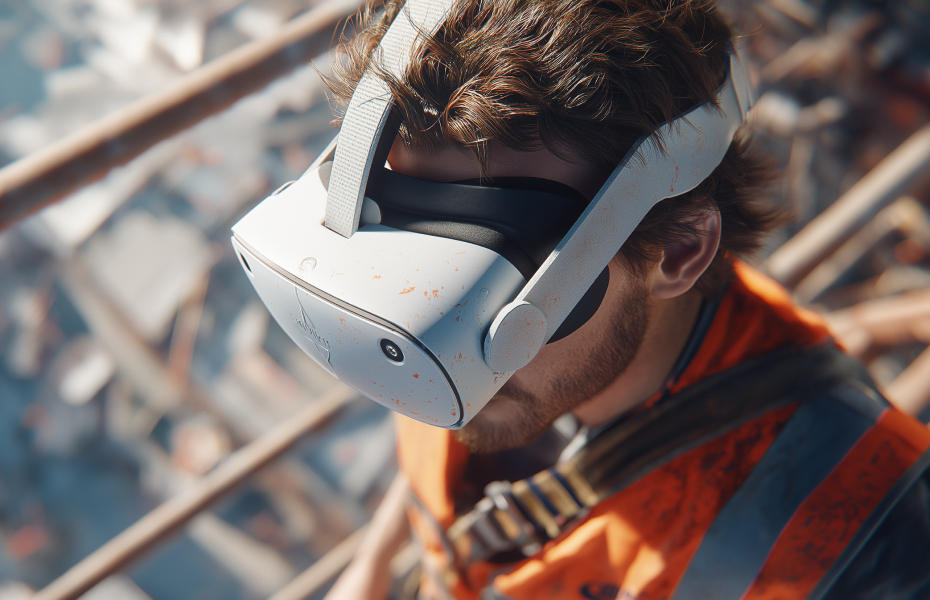
VR employee training is reshaping how organizations prepare their workforce for the hazards they will face on the job. Traditional safety programs have long depended on classroom sessions, slide presentations, and written assessments to communicate risk.
These methods deliver information, but they do not give workers the opportunity to practice responding to real scenarios in a meaningful way. Virtual reality closes that gap by placing employees inside realistic simulations where they can identify hazards, follow procedures, and build the practical skills that keep them safe when it matters most.
The Limits of Traditional Safety Training
Most organizations recognize the importance of safety training. Inductions are completed, toolbox talks are delivered, and refresher sessions are scheduled at regular intervals. On paper, the training program looks solid. In practice, the results often tell a different story.
The core problem is engagement. A worker sitting through a presentation on chemical handling or electrical isolation is receiving information passively. They may understand the theory, but they have not practiced the response.
When a genuine emergency occurs, the gap between knowing what to do and actually doing it can be the difference between a near miss and a serious injury.
Research consistently shows that passive learning methods produce retention rates as low as five percent for lectures and ten percent for reading material. The behavior change that training is supposed to create never takes hold.
Traditional methods also struggle with consistency. When training depends on individual instructors, venue conditions, and group dynamics, the experience varies significantly from session to session.
Two workers who completed the same course may have had very different learning experiences, making it difficult for safety managers to verify competency with any confidence.
What Makes VR Training Different
VR employee training replaces passive observation with active participation. Workers put on a headset and step into a three-dimensional simulation of their work environment.
They interact with equipment, navigate hazards, make decisions, and experience the consequences of those decisions in real time. The experience engages multiple senses simultaneously, creating the kind of deep, experiential learning that traditional methods cannot replicate.
This active participation is what drives the significant improvement in retention. Research shows that immersive, scenario-based learning can produce retention rates of around seventy-five to eighty percent, compared to the single-digit figures associated with lectures.
Workers remember what they practiced because they experienced it rather than simply hearing about it.
VR also eliminates the variability problem. Every employee who completes a module encounters the same environment, the same hazards, and the same assessment criteria.
Whether the training takes place on a Monday morning or a Friday afternoon, the quality and content remain identical. For organizations managing large, distributed workforces, this consistency is a significant advantage.
Key Applications Across Industries
While VR training originated in high-risk sectors like aviation and military operations, its application in workplace safety has expanded rapidly. Construction, manufacturing, oil and gas, logistics, and healthcare are all using VR to train employees on the specific hazards they face.
In construction, workers use VR to practice fall protection procedures, scaffold inspections, confined space entry protocols, and hazard identification training exercises that develop the ability to spot risks in dynamic environments.
Manufacturing teams rehearse lockout tagout sequences, machine guarding checks, and emergency shutdown procedures on virtual equipment. Healthcare workers practice patient handling, sharps disposal, and infection control in simulated clinical settings.
The common thread across all of these applications is that workers are not just told what to do. They do it. They practice it repeatedly in a safe environment until the correct response becomes automatic. This shift from knowledge transfer to skill development is what makes VR fundamentally more effective than traditional approaches for safety-critical tasks.
Measurable Impact on Safety Outcomes
Organizations that have adopted VR employee training are reporting measurable improvements in safety performance. Research in the mining sector found a forty-three percent reduction in lost-time injuries following the introduction of VR-based safety programs.
A large-scale retail implementation showed employees scoring seventy percent higher on competency assessments after VR training compared to traditional methods, with a thirty percent increase in training satisfaction.
These results are not surprising when you consider how VR works. When a worker practices responding to a gas leak in a virtual confined space, their brain processes that experience in much the same way it would process a real event.
The emotional engagement, the physical responses, and the decision-making pathways are all activated. This creates stronger neural connections than a classroom exercise ever could, which is why the skills transfer so effectively to the job site.
The performance data generated during VR sessions adds another layer of value. Every action a worker takes is recorded, from the hazards they identified to the procedures they followed and the errors they made.
Safety managers can use this data to pinpoint which employees need additional coaching and which specific procedures are causing difficulty across the workforce. This moves training from an attendance-based model to a genuine competency-based system.

Building Competency for High-Risk Tasks
The tasks that carry the greatest risk are often the ones where traditional training falls shortest. Working at height, entering confined spaces, handling hazardous energy, and responding to emergencies all require workers to perform complex procedures under pressure.
A classroom session can outline the steps, but it cannot prepare workers for the cognitive demands of executing those steps in a high-stakes environment.
VR bridges this gap by providing the closest possible approximation to real experience without the associated risks. A worker can practice a full confined space entry sequence, including permit checks, atmospheric monitoring, entry procedures, and emergency rescue, multiple times in a single session. They build procedural confidence that translates directly to safer performance on site. Platforms like Next World offer VR training simulator modules that replicate these high-risk scenarios with the detail and realism needed to produce genuine competency gains.
For organizations where regulatory bodies require documented evidence of worker competency, VR provides exactly that. The assessment data from each session creates a verifiable record of what the worker was tested on and how they performed. This is far more robust than a signature on an attendance sheet.
Integrating VR Into Your Training Programme
Implementing VR does not mean scrapping your existing safety training infrastructure. The most effective approach treats VR as a powerful layer within a broader program that still includes inductions, toolbox talks, mentoring, and on-the-job observation. The key is identifying where VR adds the most value and deploying it strategically.
Start with your highest-risk activities and most common incident types. These are the areas where the gap between theoretical knowledge and practical competency is most dangerous, and where VR will deliver the fastest return. Use your incident reports, near-miss data, and risk assessments to prioritize which safety skills training modules to introduce first.
From there, integrate VR into your regular training cycle. Use it during inductions to give new workers exposure to site-specific hazards before their first day.
Use it for refresher training to keep experienced workers sharp on procedures they perform infrequently. Use it after incidents to reinforce correct procedures and address the specific behaviours that contributed to the event.
The VR training benefits extend beyond safety performance alone. Organizations that invest in high-quality, engaging training programs tend to see improvements in employee confidence, morale, and retention. Workers recognize when their employer takes their safety seriously, and that recognition contributes to a stronger overall safety culture across the business.
Frequently Asked Questions (FAQs)
1. What Is VR-Based Employee Safety Training?
VR employee training for workplace safety uses virtual reality technology to place workers inside realistic simulations of their work environment. Workers practice identifying hazards, following procedures, and responding to emergencies in a controlled, risk-free setting that produces stronger retention than traditional classroom methods.
2. Which Industries Benefit Most From VR Safety Training?
VR safety training benefits any industry where workers face physical hazards, including construction, manufacturing, oil and gas, mining, logistics, and healthcare. The technology is particularly effective for high-risk tasks such as working at height, confined space entry, hazardous energy control, and emergency response.
3. How Does VR Training Compare to Classroom Safety Training?
VR training significantly outperforms classroom methods in engagement, retention, and skill transfer. Research shows retention rates around seventy-five to eighty percent for immersive learning compared to five to twenty percent for passive instruction. VR also provides consistent delivery and measurable competency data that classroom sessions cannot match.
4. Is VR Training Suitable for All Experience Levels?
VR training is effective for both new and experienced workers. New employees gain exposure to workplace hazards before entering the real environment, while experienced workers use VR for refresher training and competency verification on infrequently performed procedures.
5. How Does VR Employee Training Support a Stronger Safety Culture?
VR employee training supports safety culture by demonstrating genuine organizational commitment to worker protection, providing engaging experiences that workers value, and generating data that enables proactive coaching rather than reactive discipline.
When workers feel confident and competent, they are more likely to speak up about hazards and hold themselves and colleagues to higher standards.
Author:

Share Article:
Author:
Share Article: