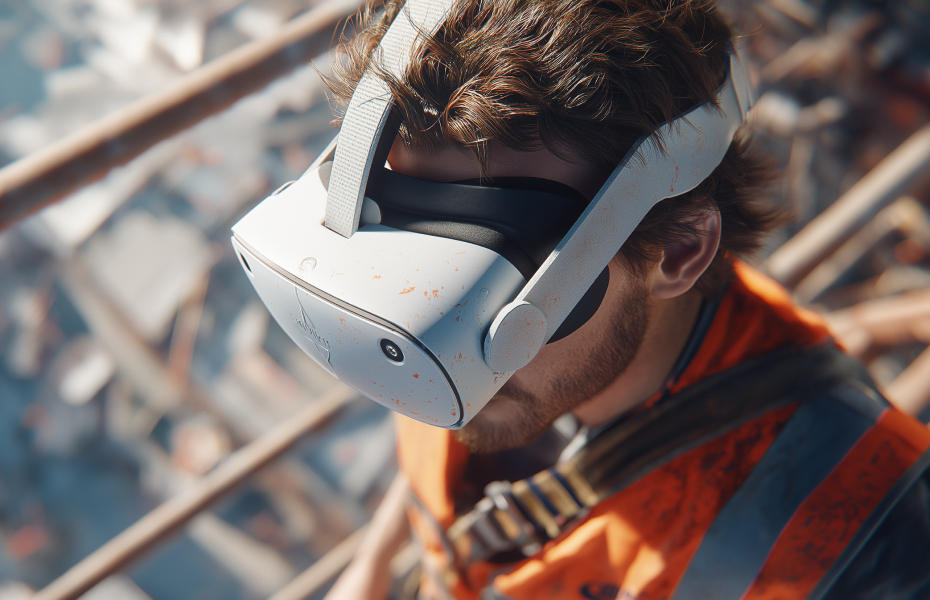
VR health and safety training is transforming how construction companies prepare workers for site hazards. The construction sector consistently records some of the highest injury and fatality rates of any industry, driven by the risks of working at height, operating heavy equipment, and navigating environments where conditions change constantly.
Traditional training covers the necessary regulatory content but struggles to build the practical competency that prevents incidents. Virtual reality addresses this gap by immersing workers in realistic simulations where they can practice procedures and develop decision-making skills without exposure to real danger.
The best practices outlined here will help construction organizations build VR programs that deliver measurable safety improvements.
Align Training Content With Site-Specific Risks
The most effective VR programs are built around the actual hazards workers encounter on their specific projects, not generic scenarios. Construction sites vary enormously in their risk profiles. A high-rise project presents different challenges from a road construction scheme or a residential development, and the training content should reflect those differences.
Start by conducting a thorough risk assessment to identify the hazards that cause the most harm. For most construction organizations, this will include falls from height, struck-by incidents, caught-in hazards at excavations, and electrocution risks. These are the scenarios your VR modules should prioritice.
Site-specific customization extends beyond hazard selection. The virtual environment should mirror the conditions workers will face, the layout of scaffolding, the types of equipment in use, and the typical traffic patterns.
When workers recognize the virtual environment as a close representation of their workplace, the skills they develop transfer more reliably to real performance.
Structure Programs Around Progressive Learning
Effective VR safety training in construction follows a structured progression rather than presenting all content in a single session. Workers need to build foundational knowledge before they can apply it in complex, dynamic scenarios.
A well-designed program typically moves through three phases. The first is guided learning, where workers are walked through correct procedures with prompts and feedback. The second is independent practice, where guidance is removed and workers must recall procedures from memory.
The VR training simulator approach supports this progression by enabling workers to repeat scenarios until they achieve consistent competency. The third is assessment, where performance is measured against defined standards and actions are recorded for evaluation.
This structure ensures workers genuinely learn from simulations rather than simply experiencing them.
Integrate VR Into Existing Training Frameworks
VR works best as a component within a broader health and safety training program, not as a standalone replacement. Classroom instruction remains valuable for delivering regulatory knowledge.
On-the-job mentoring provides the supervised real-world practice that cements skills. VR occupies the space between these two, offering immersive practice that classroom sessions cannot deliver and on-the-job training cannot safely replicate.
For induction, VR modules can follow an initial classroom orientation, giving new workers a simulated site experience before they set foot on an actual construction site.
For ongoing development, VR serves as a refresher tool workers access periodically. For task-specific preparation, VR can simulate an upcoming high-risk activity so workers rehearse the procedure before carrying it out for real.
Building a strong safety culture requires training that is consistent, engaging, and embedded in daily operations rather than treated as an annual compliance exercise. VR supports this by making training accessible and repeatable, enabling workers to revisit scenarios whenever they need reinforcement.
Prioritise the Highest-Risk Tasks
Not every aspect of construction safety training needs VR. The technology delivers its greatest value for tasks where consequences are severe and traditional training is too dangerous or impractical.
Working at height is the leading cause of construction fatalities and an ideal candidate for VR training. Workers can practice harness inspections, anchor point selection, and edge protection checks in virtual environments that replicate elevated work without the physical risk.
Heavy equipment operation is another high-value application. Operators can build spatial awareness and procedural fluency in virtual machines before working on a congested site. VR enables hazard safety training for scenarios like load failures or pedestrian near-misses that would be too dangerous to stage deliberately.
Confined space entry, excavation safety, hot works procedures, and emergency response are all areas where VR adds significant value. Focus your VR investment on these high-impact areas first, then expand as the program matures.
Recommended VR Modules for Construction Safety
The following training modules from Next World address the highest-risk scenarios construction workers face, each built around the progressive learning methodology and data-driven assessment outlined above.
This module immerses workers in a virtual jobsite where they must identify fall hazards, assess associated risks, and apply appropriate control measures at elevation.
- Covers fall prevention fundamentals including harness use, anchor point selection, and edge protection in a realistic elevated environment
- Uses a gamified assessment system that achieves average scores of 93%, reinforcing correct procedures through interactive feedback
- Available in over thirteen languages, making it accessible for multilingual construction workforces across global projects
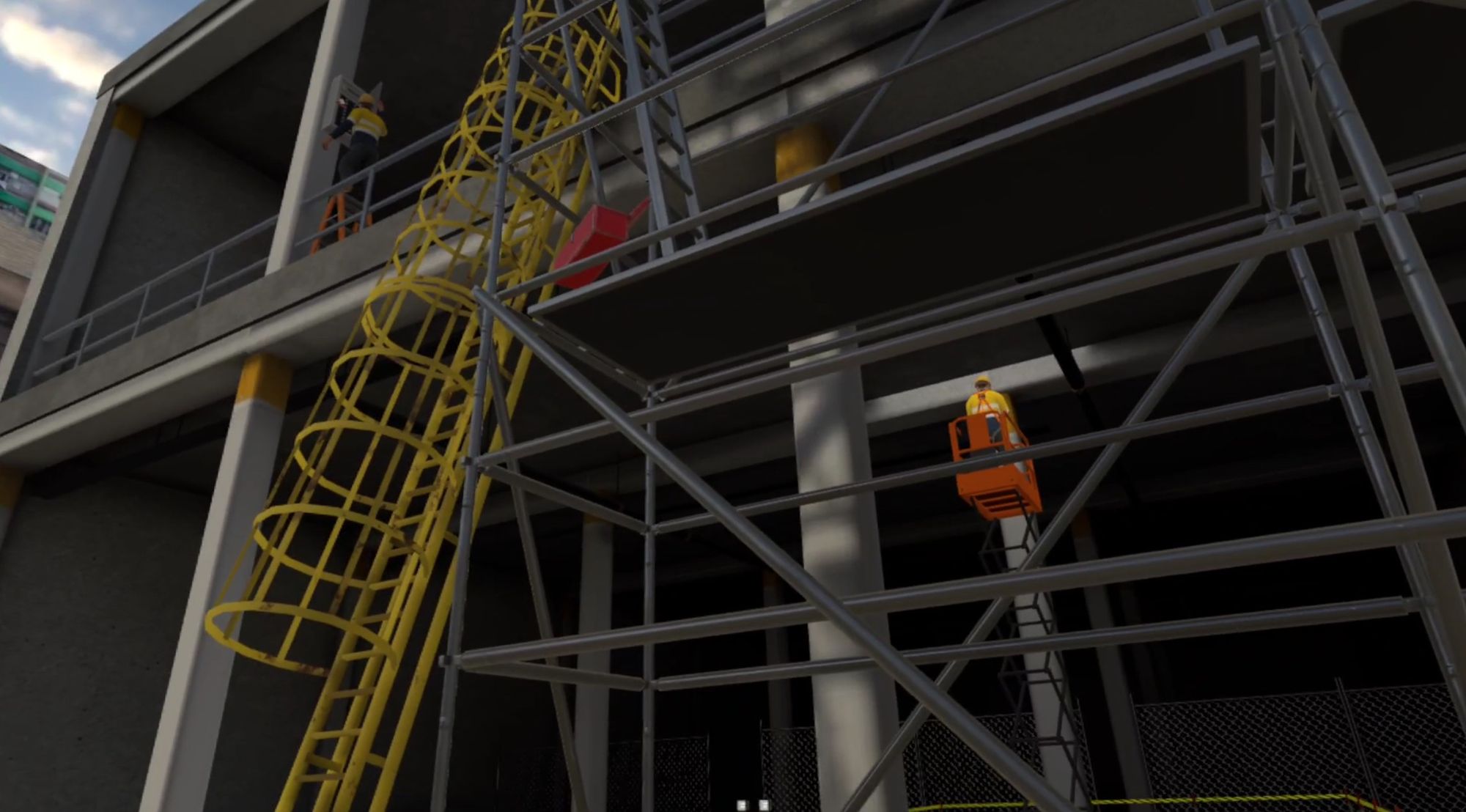
This module places workers in a dynamic virtual environment where multiple hazards are present simultaneously, training them to spot risks, assess severity, and select controls using structured safety frameworks.
- Teaches the complete risk management process including the Hierarchy of Controls and Risk Assessment Matrix through hands-on virtual practice
- Includes a full site safety risk inspection under exam conditions, building the procedural fluency needed for real jobsite walkthroughs
- Captures detailed performance data on which hazards workers identify and miss, enabling targeted follow-up training for individual competency gaps
This module trains workers on confined space entry protocols, atmospheric testing procedures, and emergency response in a controlled virtual setting that replicates the conditions of real confined work.
- Provides safe practice for one of the most dangerous construction tasks where real-world training opportunities are inherently limited
- Covers the complete entry procedure including atmospheric monitoring, permit verification, and rescue protocols through guided and independent practice phases
- Delivers consistent, standardised training that ensures every worker receives the same quality of instruction regardless of location or trainer availability
Use Performance Data to Drive Continuous Improvement
One of the most significant advantages VR brings to construction safety training is the quality of data it generates. Every session captures which hazards workers identified, which procedures they followed correctly, and where they made errors.
This data enables a different approach to training management. Instead of tracking attendance and quiz scores, safety managers can assess actual competency through objective metrics and identify patterns across the workforce.
Tracking the VR training benefits through data creates an evidence base that justifies continued investment and demonstrates compliance to regulators.
These VR platforms are designed around a data-driven methodology, enabling construction organisations to track workforce competency and connect training outcomes to on-site performance.
Ensure Accessibility and Practical Deployment
The best VR content delivers no value if workers cannot access it easily. Practical deployment considerations are critical to program success.
Hardware selection should match your operational reality. Standalone headsets offer the portability needed for active construction sites, site offices, or training centers. Session length matters as well, individual sessions should be kept between ten and thirty minutes, as shorter, focused modules are more effective and fit more easily into active project schedules.
Language accessibility is another important consideration. Construction workforces are often multilingual, and VR modules should accommodate this through visual instruction, multilingual audio, or intuitive non-verbal cues.
Frequently Asked Questions (FAQs)
1. What Construction Tasks Are Best Suited to VR Training?
Tasks with the highest consequences and the greatest difficulty in traditional delivery benefit most from VR.
Working at height, heavy equipment operation, confined space entry, excavation safety, emergency response, and hazard identification walkthroughs are all strong candidates because they involve serious risks that cannot be safely replicated through conventional methods.
2. How Should VR Training Be Structured for Construction Workers?
Structure VR training in three progressive phases, guided learning with prompts and feedback, independent practice where workers apply knowledge from memory, and formal assessment against defined competency standards. This progression ensures workers build genuine capability rather than simply experiencing a simulation.
3. Can VR Replace Traditional Construction Safety Training?
VR is most effective as a complement to existing training rather than a complete replacement. Classroom instruction delivers regulatory knowledge, VR provides immersive practice for high-risk scenarios, and supervised on-site experience cements skills in real conditions. The strongest programs blend all three approaches.
4. How Do You Measure the Effectiveness of VR Safety Training?
Measure effectiveness through the performance data VR platforms capture during each session, including hazard identification accuracy, procedural compliance, response times, and error patterns.
Compare these metrics against incident rates and audit findings from live operations to assess whether training improvements are translating into safer site performance.
5. What Are the Best Practices for Deploying VR on Construction Sites?
Use standalone headsets for portability, keep sessions between ten and thirty minutes, accommodate multilingual workforces through visual and audio design, and schedule training around project demands. Focus VR content on the highest-risk tasks first and expand coverage as the program proves its value in improving vr health and safety training outcomes.
Author:

Share Article:
Author:
Share Article: