
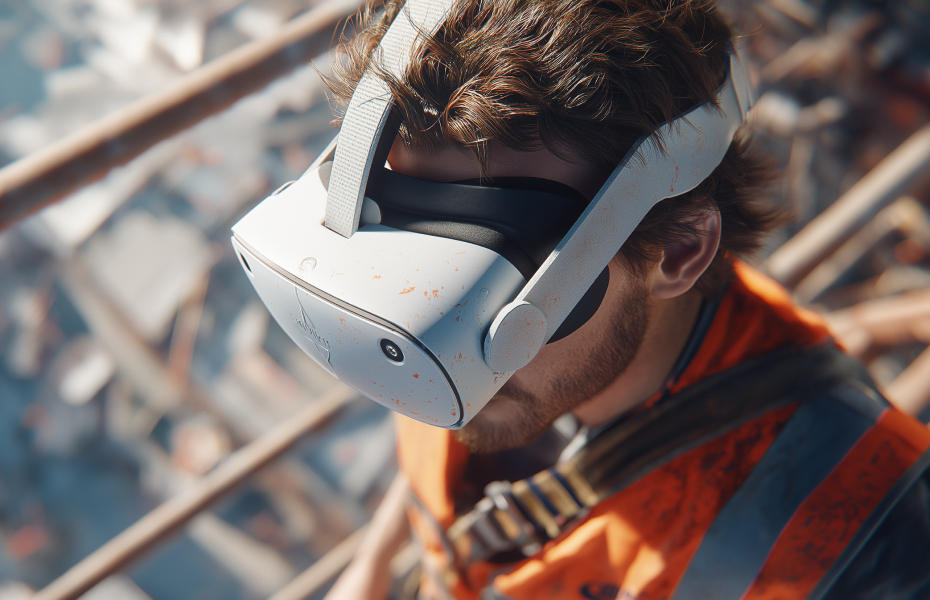
The vr training benefits that matter most on construction sites are the ones that prevent workers from getting hurt. Construction remains one of the most dangerous industries, accounting for roughly one in five workplace fatalities and over one thousand worker deaths each year.
Falls alone cause nearly forty percent of those fatalities, and the majority of fatal falls occur from heights between six and thirty feet. Traditional safety training has not solved this problem.
Fatality rates in construction have remained stubbornly consistent for over a decade, hovering around ten deaths per one hundred thousand workers annually. VR offers a fundamentally different approach, one that places workers inside realistic hazard scenarios where they build the skills and instincts needed to avoid accidents before they happen.
Higher Retention Means Fewer Errors on Site
The most immediate advantage of VR is its impact on how much workers actually remember. Research consistently shows that learners retain seventy-five to eighty percent of content delivered through immersive, experiential training. Passive methods like lectures, slideshows, and safety videos produce retention rates between five and twenty percent.
This gap in retention has direct consequences on construction sites. Workers who forget a procedure, miss a hazard, or default to shortcuts under pressure are the ones most likely to be involved in incidents.
When training content sticks, workers carry that knowledge into daily tasks and apply it consistently, even under the time pressure and physical demands of active construction work.
VR achieves this retention advantage because it engages the brain through multiple channels simultaneously.
Workers are not watching a demonstration; they are performing the task. They are making decisions, using their hands, scanning their environment, and experiencing the consequences of their choices. This active, full-body engagement creates stronger neural pathways than any passive method can produce.
Realistic Hazard Exposure Without Real Risk
Construction sites present hazards that are inherently difficult to train for safely. You cannot drop a worker from scaffolding to teach fall protection. You cannot expose someone to an electrical fault to demonstrate lockout procedures. You cannot collapse a trench to show why shoring matters.
VR removes this barrier entirely. Workers experience these high-risk scenarios in a controlled virtual environment where mistakes carry no physical consequences.
They feel the height when standing on a virtual rooftop edge. They see the trench walls shift when excavation safety is compromised. They watch a load swing unexpectedly when rigging procedures are not followed correctly.
This exposure to realistic risk builds something that classroom training cannot, genuine hazard awareness. Workers who have experienced a virtual fall develop a visceral understanding of why fall protection matters.
That emotional imprint drives behavior change in ways that reading about fall statistics never will. Effective hazard identification depends on workers who can recognise dangers instinctively, and VR trains that instinct through repeated, realistic exposure.
Measurable Reduction in Accidents and Injuries
The vr training benefits extend beyond theory. Organizations that have implemented VR safety training report concrete, measurable reductions in incident rates.
A study tracking the introduction of VR in the mining sector found a forty-three percent reduction in lost-time injuries. Manufacturing firms using immersive safety training have documented injury reductions of up to seventy percent.
A large pharmaceutical company reported a twenty-five percent reduction in safety incidents after piloting VR-based training programs. Research involving two hundred participants showed that VR training increased safety awareness by thirty percent compared to traditional methods.
These results come from the fundamental shift in how VR trains workers. Rather than testing whether someone can recall information, VR tests whether they can perform correctly under realistic pressure.
Workers who demonstrate competence in a VR scenario are far more likely to perform correctly on an actual construction site than those who simply passed a written assessment.
Meta-analyses of VR safety training research confirm that VR significantly outperforms traditional methods across behavioral, skills-based, and experiential measures, with the strongest effects observed in experiential learning outcomes.
Faster Training With Less Disruption
Construction projects operate under tight schedules and budgets, and pulling workers off site for training costs money. Traditional safety sessions often require half-day or full-day classroom blocks, travel to training centres, and physical equipment that is expensive to maintain.
VR compresses training timelines significantly. Research indicates that VR trainees complete training four times faster than their classroom counterparts while achieving equal or better outcomes. A focused VR module runs ten to twenty minutes and delivers the practical content that would take hours to cover through conventional methods.
This efficiency is among the most practical vr training benefits on construction projects where every hour of lost productivity affects the schedule.
Workers complete their training, put the headset down, and return to productive work in a fraction of the time traditional methods require. The faster turnaround also makes it practical to train large crews without shutting down entire operations.
Standardized Training Across Every Site
Construction firms typically operate across multiple projects with varying crews, subcontractors, and site conditions.
Ensuring that every worker receives the same quality of safety instruction is a persistent challenge. Trainer quality varies, classroom delivery is inconsistent, and workers who transfer between sites may have received very different levels of preparation.
VR eliminates this variability. Every worker who puts on a headset receives the same scenarios, the same assessment criteria, and the same performance standards regardless of location, trainer, or schedule. This consistency is particularly valuable for organisations managing QHSE management frameworks where standardized training is a compliance requirement.
Multilingual capability strengthens this consistency further. Leading VR platforms deliver content in fifteen or more languages, ensuring that every worker on a diverse construction crew receives effective training regardless of their primary language.

Objective Data for Smarter Safety Decisions
Traditional training generates attendance records. VR generates performance data, response times, decision accuracy, hazard safety training scores, procedural compliance rates, and detailed error patterns for every worker in every session.
This data changes how safety managers operate. Instead of assuming that workers who attended training are competent, managers can see exactly which workers identified all hazards, which missed critical steps, and which need additional practice before being assigned to high-risk tasks.
Patterns across the workforce reveal which topics produce the weakest performance, allowing targeted intervention rather than blanket retraining.
The financial case strengthens when these analytics connect to incident data. The cost of a single medically consulted construction injury averages forty-three thousand dollars, and employers collectively pay over one billion dollars per week in workers' compensation.
Studies show that every dollar invested in effective safety programs returns four to six dollars in reduced incident costs. VR training data provides the evidence to demonstrate that return and justify continued investment.
Building a Culture of Proactive Safety
Perhaps the most significant of all vr training benefits is the shift in how workers and organizations think about safety. Traditional training often positions safety as a compliance obligation, something workers endure to satisfy regulatory requirements. VR transforms safety training into an engaging, memorable experience that workers value.
When training is immersive and realistic, workers develop personal ownership of their safety skills. They recognize that the training is genuinely preparing them for situations they will encounter, not wasting their time with information they already know.
This shift in attitude supports a broader immersive learning culture where safety is seen as a shared priority rather than an administrative burden.
Next World provides construction-focused VR training modules covering working at heights, hazard identification, and emergency response, delivered on wireless headsets with built-in analytics that give safety managers the performance data they need to make informed decisions.
Frequently Asked Questions (FAQs)
1. How Does VR Reduce Construction Site Accidents?
VR trains workers through realistic, immersive scenarios where they practice hazard recognition, equipment operation, and emergency procedures without physical risk. This hands-on approach builds stronger retention and hazard awareness than passive methods, leading to measurable reductions in incident rates of up to forty-three to seventy percent.
2. What Makes VR More Effective Than Traditional Safety Training?
Workers retain seventy-five to eighty percent of content through VR compared to five to twenty percent from lectures. VR engages learners through active decision-making and physical interaction rather than passive observation, and it allows safe practice of high-risk scenarios that cannot be replicated in a classroom.
3. How Quickly Can Construction Workers Complete VR Training?
VR modules typically run ten to twenty minutes and deliver practical content that would take hours through conventional methods. Research shows VR trainees complete training four times faster than classroom learners while achieving equal or superior outcomes.
4. What Kind of Data Does VR Training Provide to Safety Managers?
VR captures response times, decision accuracy, hazard identification rates, procedural compliance scores, and error patterns for every session. This data reveals individual and workforce-wide competency levels and provides objective evidence for regulatory compliance.
5. What Is the Financial Return on VR Safety Training for Construction Firms?
Studies indicate that every dollar invested in effective safety programs returns four to six dollars in reduced incident costs. With the average medically consulted construction injury costing forty-three thousand dollars, even a modest reduction in incidents produces significant savings that justify the vr training benefits investment.
Author:

Share Article:
Author:
Share Article: